Lewisville, TX · Denton County
Storm Damage Roof Repair in Lewisville, TX
Wind-lifted shingles, blown-off ridge vents, torn flashing and tree strikes. Emergency tarping first, permanent restoration second, insurance documentation throughout.
If you need storm damage roof repair in Lewisville, TX, the priority order is stop the water, document the damage, then repair properly. Doing those in the wrong order is how homeowners end up with interior damage they cannot claim and a roof repaired to a scope that does not cover what actually happened.
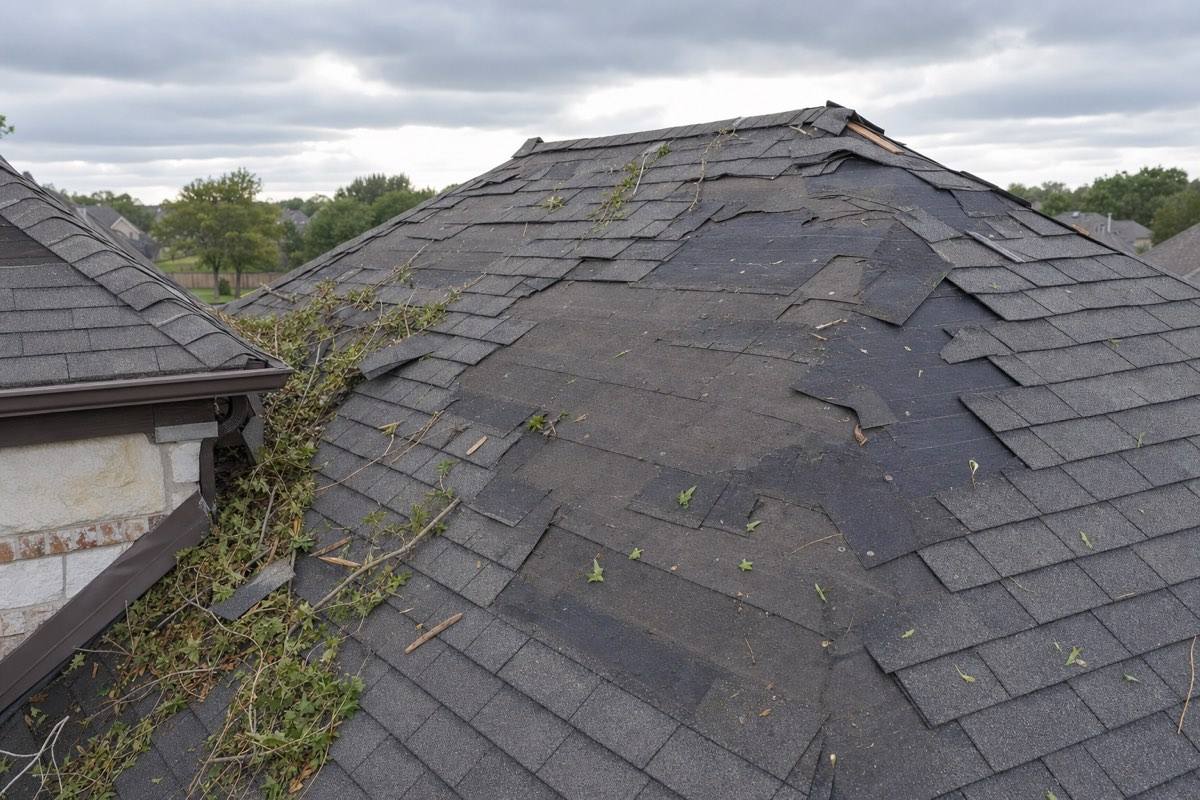
What North Texas Storms Do to Roofs
Hail gets the attention, but straight-line wind does more roof damage across North Texas than tornadoes do, and it does it in a way that is far harder to see. Severe thunderstorms in March 2025 brought damaging winds up to 80 mph and spin-up tornadoes through Denton County, with scattered power outages and several Lewisville buildings sustaining major damage.
Wind almost never takes a whole roof. What it does is break the thermal seal between shingle courses along the leading edges, at the rakes, at the ridge and around any raised detail. Those shingles are still nailed down and still look normal from the street, but they are no longer bonded to the course below, so every subsequent storm drives rain up underneath them. A roof that visibly lost four shingles has commonly lost the seal on forty.
- Wind-lifted and creased shingles. A crease across a shingle means it folded back and returned. The mat is fractured along that line even though the shingle is still in place.
- Blown-off ridge caps and ridge vents. The most exposed line on the roof, and a direct opening into the attic at the peak when it goes.
- Torn or lifted flashing. Wind gets under counterflashing at chimneys and sidewalls and peels it away from the wall surface.
- Tree strike and limb damage. Even a limb that does not puncture the deck will scrape a whole slope clean of granules and pack the valleys with debris.
- Debris impact punctures. Wind-borne debris hitting at 80 mph will go through shingles and decking.
- Gutter and downspout separation. Gutters torn from the fascia take the fascia board and sometimes the roof edge with them.
Emergency Tarping and Why It Matters for Your Claim
Most homeowners policies impose a duty on you to mitigate further damage after a loss. In practical terms that means if water is coming into the house and you do nothing for four days, a carrier can argue that the resulting interior damage was avoidable.
Emergency tarping satisfies that duty. It is a properly fastened, weighted tarp installed over the opening so the roof sheds water until a permanent repair can be made. It is not a bin bag and a brick, and it is not something to attempt on a wet roof that has just taken structural damage.
Before we cover anything, we photograph it. A tarp that goes on before the damage is documented makes the adjuster's job harder and your claim weaker. Keep the tarping invoice too, because reasonable mitigation costs are typically recoverable under the claim.
Storm Damage Versus Wear and Tear
This distinction decides most claims. Insurance covers sudden accidental damage from a covered peril. It does not cover a roof that wore out. Adjusters are trained to separate the two, and genuine storm damage has signatures that wear does not.
| Indicator | Storm damage | Wear and tear |
|---|---|---|
| Pattern | Directional, concentrated on storm-facing slopes | Uniform across all elevations |
| Shingle edges | Sharp fresh fractures, clean creases | Rounded, weathered, gradually eroded |
| Granule loss | Concentrated at impact points, clean asphalt exposed | Even thinning across the whole surface |
| Collateral evidence | Dented gutters, vents, AC fins, screens | None |
| Onset | Traceable to a specific date of loss | Developed gradually over years |
| Underlying shingle | Still flexible and otherwise sound | Brittle, curling, at end of service life |
An honest inspection tells you which column you are in before you file. If the roof is simply worn out, a storm claim will be denied and you will have a denied claim on your record for nothing.
After the Storm in Lewisville: What to Watch For
Within days of any significant Denton County storm, unfamiliar trucks appear in Lewisville neighborhoods. Some belong to legitimate out-of-area crews supplementing local capacity. Many belong to operations that will have moved to the next storm market before your workmanship warranty is worth anything.
The tells are consistent. Pressure to sign today. An offer to waive or absorb your deductible, which is an offense under Texas law and a signal that costs are being cut somewhere else. A contingency agreement pushed at the door that binds you to them regardless of the claim outcome. No verifiable manufacturer certification, no local address, and no certificates of insurance offered up front.
Ask any contractor for their GAF or manufacturer certification number and verify it on the manufacturer's own website, not on a document they hand you. Ask for certificates of general liability and workers compensation coverage. Any legitimate roofer produces both without hesitation.
Warning signs
Signs Your Roof Took Storm Damage
Check these after any significant wind or hail event, even if the roof looks untouched.
Shingles in the yard or against the fence line
Any shingle on the ground means the roof lost adhesion somewhere, and the visible loss is almost always the smallest part of the problem. Shingles adjacent to the missing ones have usually lost their seal as well and will go in the next storm.
Creased or folded-back shingles
Look for a horizontal line across a shingle where it folded and came back down. The mat is fractured along that crease and the shingle will fail there, even though it looks like it is still doing its job.
Missing or displaced ridge caps
The ridge is the most exposed line on the roof and the easiest damage to see from the ground. Gaps along the peak are an open path into the attic and need attention before the next rain.
Debris packed into valleys
Leaves, twigs and small branches accumulating in a valley dam water and force it sideways under the shingles. After a wind event this is the first place we look and one of the most common causes of post-storm leaks that appear weeks later.
New water stains after a storm that were not there before
A stain that appears within days of a storm ties the interior damage to a specific date of loss, which matters for your claim. Photograph it immediately with the date visible.
Gutters pulled loose or full of granules
Gutters separating from the fascia indicate wind load on the roof edge. Heavy granule deposit in the gutter after a storm indicates hail stripped the surface, even if you saw only small stones fall.
Our process
Our Storm Response Process
Stop the water, capture the evidence, get the scope right, then rebuild.
Emergency call and same-day dispatch
Our line is answered 24 hours a day, including during active storms. If water is entering the building we prioritize you over scheduled work.
Document, then tarp
We photograph the damage before we cover it, then install a properly fastened and weighted emergency tarp to stop further intrusion and satisfy your policy's mitigation duty.
Full inspection and claim documentation
Once conditions allow, a complete inspection of every slope, flashing and penetration, with photographs, measurements and a written findings report for your carrier.
Adjuster meeting and permanent restoration
We meet your adjuster on the roof to agree the scope of loss, then schedule and complete the permanent repair or replacement to that approved scope.
Why choose us
Why Choose Us for Storm Damage
We Answer at 3am During the Storm
Storm damage does not wait for Monday, and the hours when most roofing offices are closed are precisely the hours when water is entering the building. Our emergency line is answered 24 hours a day, every day, including during active severe weather, and we tarp in the dark and in the rain because we carry the fall protection and equipment to do it safely.
Documentation Before Tarping, Every Time
A tarp installed before the damage is photographed makes your adjuster's job harder and your claim weaker, and it is a mistake we see constantly on roofs other crews reached first. We photograph the full extent of the damage, then cover it, then hand you the file. It costs us ten extra minutes and it protects the claim.
A Local Contractor, Not a Storm Chaser
We were working Denton County roofs before this storm and we will be here for the next one. That matters because a workmanship warranty is only worth as much as the company standing behind it, and the operations that arrive in convoy after a major hail event are structurally not built to be reachable in five years.
Our commitments
Why Lewisville Property Owners Trust Us
Free, No Pressure Inspection
Every inspection is free and comes with a written findings report and photographs of what we actually saw on your roof. If the roof has life left in it, we tell you that and we do not quote a replacement.
GAF Master Elite Certified
GAF awards Master Elite status to a limited share of roofing contractors nationwide. It requires proof of licensing, insurance and an ongoing performance record, and it is what allows us to register the enhanced GAF system warranties on the roofs we install.
Licensed and Fully Insured
Texas does not license roofers at the state level, which is exactly why this matters. Our contractors carry general liability and workers compensation coverage, and we will hand you the certificates before anyone sets a ladder against your house.
We Handle the Insurance Claim
Hail and wind claims turn on documentation. We meet your adjuster on the roof, provide the photo evidence and measurements, and make sure the scope of loss reflects the damage that is actually there.
By city
Storm Damage Roof Repair Near You
Housing stock, roof age and storm exposure change from city to city, and so does this job. Each page below covers what is specific about storm damage roof repair in that community.
- Storm Damage Roof Repair in Flower Mound, TX
- Storm Damage Roof Repair in Highland Village, TX
- Storm Damage Roof Repair in Carrollton, TX
- Storm Damage Roof Repair in The Colony, TX
- Storm Damage Roof Repair in Coppell, TX
- Storm Damage Roof Repair in Denton, TX
- Storm Damage Roof Repair in Corinth, TX
- Storm Damage Roof Repair in Grapevine, TX
Related Roofing Services
Answers
Storm Damage Questions
Should I tarp the roof myself before you arrive?
Please do not go on the roof. A roof that has just taken storm damage may have compromised decking that will not hold your weight, and wet roofing is genuinely dangerous. Contain water inside instead: move belongings, place buckets, and if a ceiling is bulging with trapped water, pierce the low point with a screwdriver to release it in a controlled way. Then call us.
Does homeowners insurance cover storm damage to a roof?
Wind and hail are covered perils under most Texas homeowners policies, subject to your wind and hail deductible, which is often a percentage of the dwelling coverage rather than a flat figure. What is not covered is a roof that simply wore out. We inspect and tell you which situation you are actually in before you file.
How quickly can you get to my property after a storm?
Emergency calls with active water intrusion get same-day dispatch. After a widespread event, non-emergency inspections are scheduled in the order received, and we are honest about the queue rather than promising a time we cannot hold. Tell us on the call whether water is coming in, because it changes your place in the line.
What if a tree fell on my roof?
Do not enter the affected part of the house if there is any sign of structural movement, and call us immediately. Tree strikes frequently damage the framing rather than just the roof covering, so the assessment has to cover structure as well as roofing. We stabilize and tarp first, then document the full extent for your carrier.
Can you work with my insurance company directly?
We provide documentation, meet your adjuster on the roof, and advocate for a scope of loss that matches the damage. We do not file, negotiate or settle claims, because public adjusting is a separately licensed activity in Texas and we are roofers. The claim stays yours and the decisions stay with you.
Storm Damage? Call Now, We Answer 24/7
Emergency tarping, full photographic documentation for your claim, and permanent restoration by a contractor who will still be here in five years.